
Republic County Civil Docket Searches
Start at Kansas CaseSearch. Pick District from the menu and choose Republic. Enter a Case Number if you have one. The portal also lets you search by Party Name, Business Name, or Party As Business Name, each as its own mode. Filter by Civil, Family, or Probate or Mental Health only when that fits the matter you want.
Finish the human check. Confirm the case header is the right one, and work down the dated event index. A filing you expected may be missing from the list. If so, call the Clerk of the District Court at 785-527-7234. The public terminal at 1815 M Street in Belleville is another route.
- Choose District and a search type.
- Enter the exact term and select Republic.
- Add the correct case filter.
- Complete the human check and verify the header.
- Use the clerk or terminal for missing documents.
Republic Civil Portal Filters
Republic appears as a county option, not a city. Date filters can trim a long name search, though stacking too many may bury a valid match. Also note that a business-name hit in a case result is not a corporate, property, tax, or license history.
| Control | Choice | Use |
|---|---|---|
| Court | District | Trial cases |
| County | Republic | County records |
| Case Type | Civil, Family, Probate | Record family |
| Search Type | Number, party, business | Index key |
Current civil case numbers follow the pattern RP-[year]-CV-[six digits]. Older compact numbers may require help from the clerk.
Civil Dockets: What They Show
A Republic County civil docket lists neutral case data plus a dated event index. A pleading makes a request; a motion asks for action; a setting reserves court time. Only a signed order or judgment records what the judge actually decided.
| Case Number | Republic prefix, year, civil type, and sequence. |
|---|---|
| Parties | Public caption and counsel where allowed. |
| Filings | Petition, answer, service, and exhibits when public. |
| Motions | Requests and later ruling events. |
| Judgment | Signed result, dismissal, or other closing order. |
Republic Civil Filings in FY2025
The official FY2025 table counts 220 Republic County civil filings. That total breaks down further. It includes 11 regular actions, 164 limited actions, and 45 domestic-relations filings. Limited actions include 163 contract entries. These are aggregate counts, not findings about any named party.
Republic County civil docket filings totaled 157 in FY2024, though the official court records offer no explanation for why the count moved.
Republic Limited Actions Need Context
Limited actions dominate the visible FY2025 civil docket in Republic County. The official row counts 164 filings, 163 of them contract entries. That number is useful local docket context and nothing more. It reveals no contract terms, no party names, and proves no liability. The count cannot explain why the category moved up or down either.
Want to follow a single limited-action case? Search its exact case number when you have it. Confirm the Republic County District Court header first. Then sort the events into service, pleadings, motions, settings, orders, and any judgment. A motion for judgment is not the judgment itself. A service entry marks a procedural step, not the truth of a claim.
An online event may list a document with no image. Write down the title and date before calling the clerk. Precise requests are easier to fill. A broad demand for every civil record under a common name is not. Ask the office about current copy cost and delivery method. The official sources set no Republic-specific civil copy fee.
What Cases Fill the Civil Docket
Republic County District Court handles regular contract, tort, real-property, and other actions. Limited actions form a separate category. Small claims stay within district court as well. Family, probate, guardianship, conservatorship, and mental-health files use the same structure, though access can be stricter.
- Regular contract, tort, and real-property actions
- Limited civil actions
- Small claims
- Domestic-relations matters
- Probate and protected fiduciary matters
Republic Small Claims Stay District
K.S.A. 61-2703 caps small claims at $10,000, excluding interest, costs, and damages. Republic County has no separate justice-of-the-peace docket. Small claims ride the district-court routes. The statute itself sets out the rule.
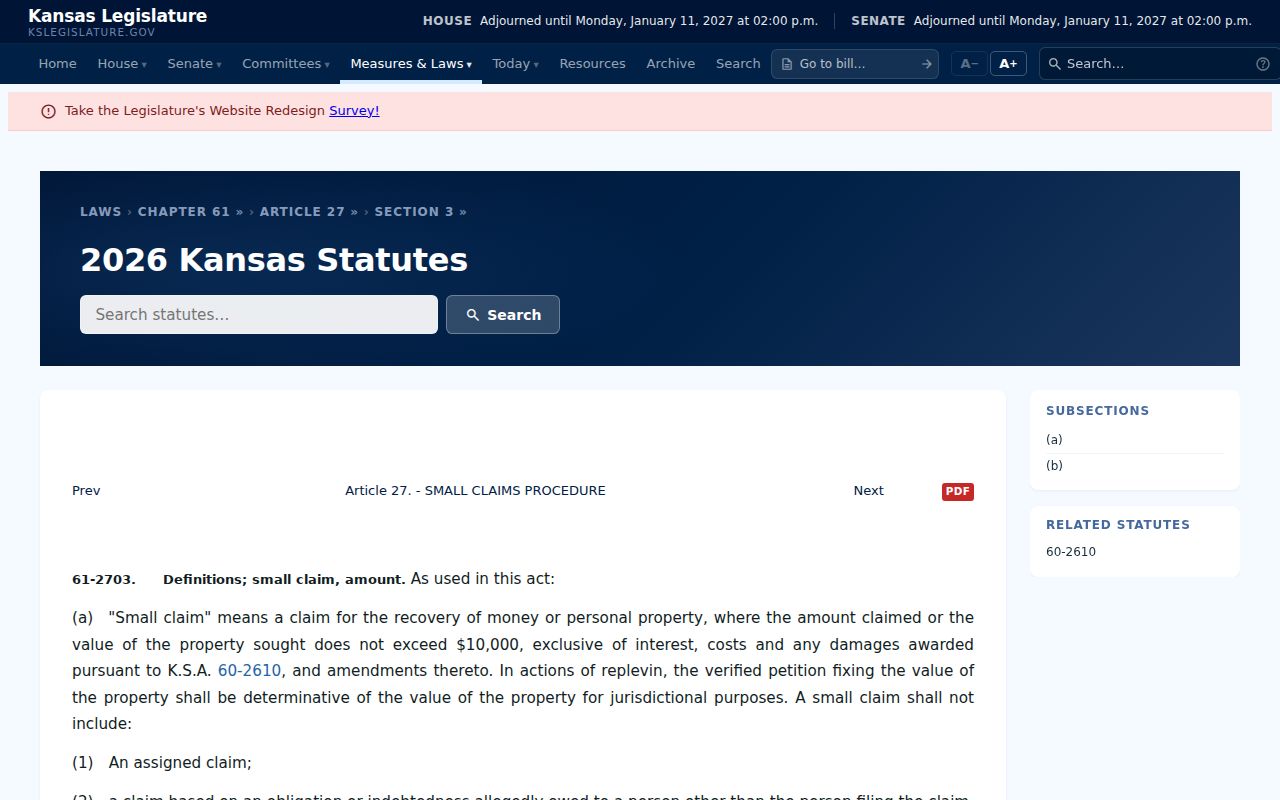
The statute confirms the routing rule for Republic County: small claims remain Kansas District Court cases.
Hearings on the Civil Docket
Motion, status, scheduling, pretrial, and trial settings can all appear on the civil docket. A setting is never an outcome. Check later events for a continuance, reset, order, or judgment. Trust the latest written notice plus direct court communication above all. The court posts no standalone daily docket. So CaseSearch, the terminal, the clerk, and Republic County court schedule routes are the working checks.
Missing Republic Civil Documents
An event can show up with no complaint, exhibit, or order attached online. Note the case number, the document title, and the date, then ask the clerk for that specific item. The terminal sometimes holds public pre-eCourt material the website lacks. The 12th Judicial District joined eCourt in November 2020.
For family or probate records, Rule 22, a sealing order, or redaction may explain the gap. Child, medical, financial, and fiduciary material deserves extra care. A missing image does not mean a lost file. Remember that the docket index is only a finding aid; the filed document or signed judgment carries the full court text.
Republic Docket Entries Versus Judgments
A docket entry is a signpost. It tells you a petition, answer, motion, hearing, or order exists, and when it hit the file. The label rarely states the relief sought. For real detail, read the filed document or request a copy from the Clerk of the District Court.
This gap matters most as a case winds down. A hearing setting is not a judgment. A motion entry is not a ruling. A default request does not prove a default judgment was entered. Scan the later entries for the signed order, judgment, or dismissal that actually closes the case, and confirm any formal copy rule with the receiving office.
Kansas CaseSearch describes its public information as general reference, not the official record. The courthouse terminal reaches more lawful public material. A certified copy comes only through the clerk. Certification authenticates the page; it adds no facts or legal meaning beyond the court document itself.
Republic Family Records Need Care
The FY2025 civil table lists 45 domestic-relations filings. That Republic County figure folds in aggregate protection-from-abuse and protection-from-stalking categories. The totals are safe context. They do not license publishing names, addresses, child details, financial facts, or protected filing contents.
CaseSearch offers a Family filter. It helps surface permitted case information but makes no document public by itself. Rule 22 keeps many dissolution, custody, visitation, support, and parentage records off electronic access. Seeing a header while a petition or exhibit stays hidden is normal. Ask the clerk about lawful access rather than guessing.
Probate and mental-health searches deserve the same restraint. Access follows the record and rule, not the dropdown. Use the case number, request one specific document, and keep protected facts out of any notes.
Who Can See Civil Dockets
Republic County civil access comes three ways. Try online, the courthouse terminal, or the clerk. Civil information may sit in any of these, but Rule 22 excludes sensitive documents from electronic access, so a public header does not make every dissolution, custody, support, parentage, guardianship, or financial filing downloadable.
Key Rules:
Rule 22 governs electronic access and exclusions.
District-court records guidance separates case information from documents.
The KORA request route supports a defined public-record request.
The clerk finds files, explains formats, and quotes current costs. Interpreting a claim or judgment is outside that office, and CaseSearch remains general reference rather than a certified court record.